Building an Evening Ritual: The Other Half of Your Morning Routine
We talk a lot about morning routines. Wake early, drink water, meditate, journal, move your body, eat something nourishing, set an intention for the day. There are entire industries built around how we begin.
But almost nobody talks about how we end.
For most of the women I work with, and honestly for most of my own life too, the evening was never really an ending. It was just the moment the demands finally stopped. You finish the last task. You wipe down the kitchen counter. You answer one more email you told yourself you wouldn't answer. You check tomorrow's calendar so you can fall asleep with a plan already running in your head. Then you get into bed and you scroll, because that is the first moment all day that feels like it belongs to you.
Your body might be exhausted, but your nervous system never got the memo that the day is over.
An evening ritual is how you send that memo.
I don't mean another elaborate routine to perform correctly, or twelve more tasks stacked onto a day that is already full. I mean a handful of small, repeated signals that tell your whole system we are done for today. That's it. That's the entire premise.
Your evening starts before you get into bed
I like to think of the ninety minutes before sleep less as a schedule and more as a slow descent. The house gets quieter. The lighting softens. Your movements slow down without you forcing them to. You are essentially building a different sensory world than the one you spent all day in.
Here is how I think about it, broken into pieces you can actually use.
Lower the lights
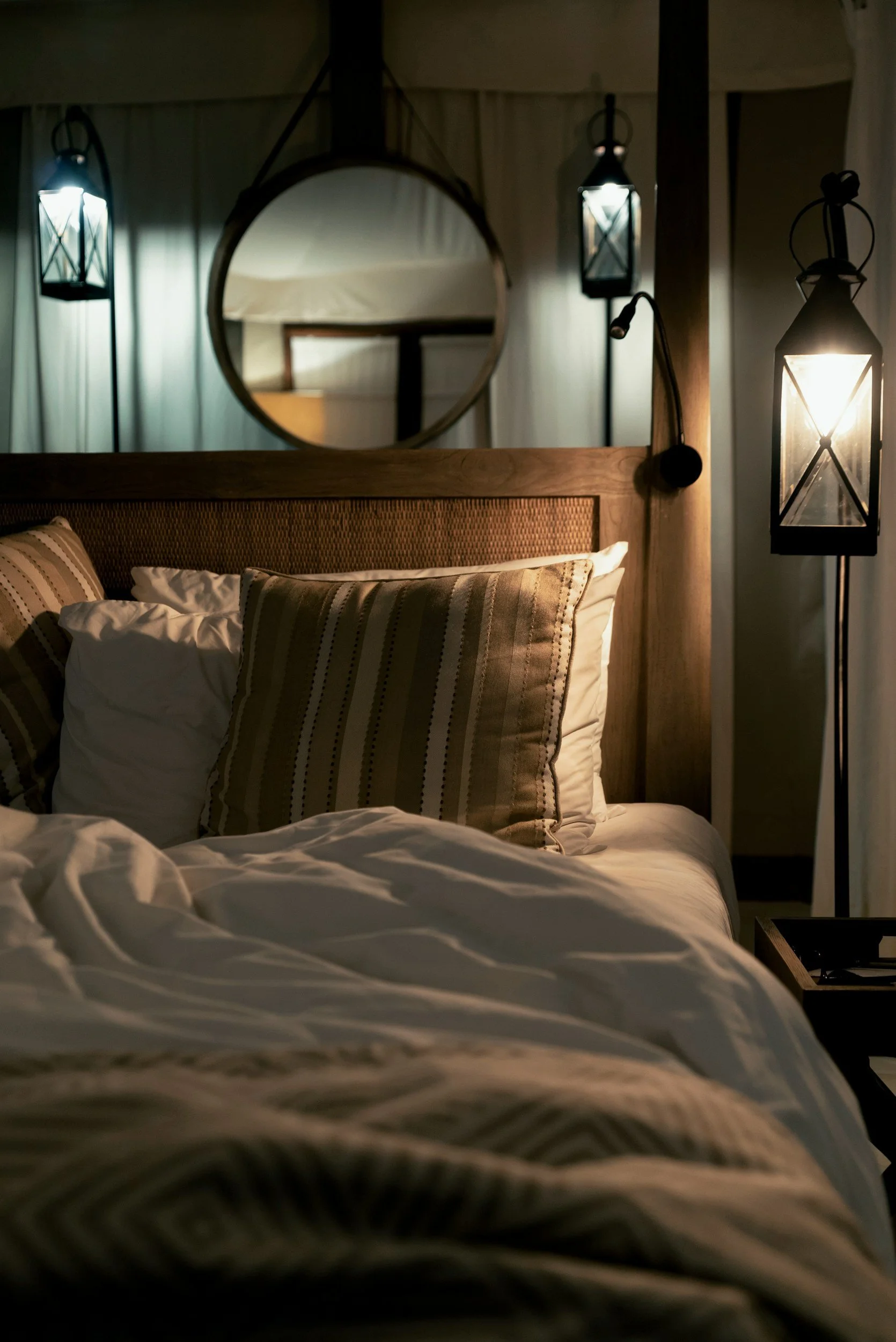
Our bodies read light as information, and bright overhead lighting late into the evening keeps everything feeling like the middle of the afternoon. As it gets later, I switch off the main lights in my house and turn on a lamp or two instead. There is something almost startling about watching your home change shape as the day winds down. It becomes a physical reminder that you are allowed to stop producing now. If ninety minutes feels like a lot, five will do. Turn off the brightest lights and switch on something softer. That alone can mark the start of your ritual.
Add some warmth
Ayurveda has used warmth and oil for centuries as a way to settle a busy mind or a depleted body, and I have come to trust that completely. A warm shower can become more than hygiene once you start treating it as a transition rather than a chore. Let the water mark the close of your working day. I also love massaging warm oil into my feet before bed. It sounds like a small thing, and it is, but it pulls your attention out of your head and back into your body in a way that almost nothing else does. You don't need a complicated routine here. The value comes from repeating the same small act night after night until your body learns what it means. If you only have five minutes, warm a bit of oil in your palms and massage your feet slowly. Put on socks after if you want. No phone, no multitasking. Just five minutes of your own hands on your own skin.
Dinner supports your sleep
A heavy meal eaten too close to bedtime leaves your body working hard on digestion right when you're asking it to rest. When you can, give yourself some space between dinner and sleep, and choose a meal that satisfies you without leaving you overly full. I'm not talking about rigid food rules. I'm talking about starting to notice the relationship between when you eat, what you eat, and how you actually sleep that night. Your body usually tells you more than any wellness trend ever will. On the nights when dinner is late or heavier than usual, let go of doing it perfectly. Eat slowly, sit down while you eat, and give yourself a few quiet minutes afterward instead of moving straight into the next task.
Give your phone a bedtime
This is the hard one for most of us, myself included. The phone has become our desk, our newspaper, our television, our social life and our calendar, all in one object we carry into bed with us. Scrolling feels compelling at night precisely because it might be the only unstructured part of your entire day. I don't think of this as a discipline problem. I think of it as a boundary that has to feel realistic or it won't last. Maybe your phone charges in another room. Maybe it just sits across the bedroom out of reach. Maybe you pick a time after which you stop answering work messages and close the apps. The goal was never digital perfection. It's creating a small window where nothing new is pouring into your nervous system. Even five minutes without your phone before the light goes out is a start, and five minutes has a way of becoming ten, then thirty, once your body gets used to it.
Move differently than you did all day
Exercise absolutely has its place, but your body at nine at night is not asking for another workout. In the evening I reach for slow, floor based movement instead. A supported child's pose. Legs resting up against the wall. A gentle reclined twist. Sometimes I just lie on my back with one hand on my chest and one on my belly and stay there. There's nothing to achieve and nowhere to get more flexible. You are simply letting your body get heavy. Two restorative positions held for a couple of minutes each is genuinely enough.
Let your breath be the last cue
You don't need an elaborate breathwork practice to close out your day. Let the inhale arrive on its own, and let the exhale get a little longer and a little softer than usual. Don't force it or chase a particular feeling. Notice your jaw. Your shoulders. Your hands resting on whatever is holding you up. Each exhale is a small way of setting the day down. Ten slow breaths, exhale a touch longer than the inhale, and then stop doing anything at all. Just rest.
When the evening gets away from you
Some nights there is no ninety minute wind down. There are late meetings, a child who needs you, a flight to catch, a deadline, dinner out with friends, a pile of laundry, a phone call you didn't see coming, and suddenly it's ten forty seven and you're still standing in the kitchen wondering how that happened.
Your ritual hasn't failed. It was never meant to be a standard you had to meet perfectly every single night.
On those nights, choose three things. Lower the light. Put the phone away. Take ten slow breaths. That's the whole ritual, and it still counts.
Consistency matters far more than complexity. Over time, even a very small sequence starts to feel familiar in your body. The lamp clicks on. The phone goes across the room. The oil comes out. The breath slows down on its own because it knows what comes next. The day is ending, and you get to stop now.
Morning and evening were always meant to go together
If you already have a morning practice, think of an evening ritual as its natural partner. Your morning asks how you want to enter the day. Your evening asks how you want to leave it. Together they build the bookends around everything that happens in between.
This is how I think about wellness at Ritual, not as one more thing to squeeze into an already full life, but as a rhythm that quietly changes how you live inside that life. Sometimes the whole shift starts with something almost embarrassingly ordinary. A cup of tea. Warm oil on your feet. A dim room. A few minutes on the mat. A breath that finally tells your body nothing else is required of it tonight.
If you would like some support building more space between the activity of your day and the quiet of your evening, come join us for an evening class at Ritual Wellness Center in Rancho Santa Fe. Our small group practices are built to help you slow down, come back into your body, and take home a rhythm of restoration that is actually yours.
And if it's your mornings that need more intention rather than your evenings, our companion guide on building a morning ritual is a good place to start.
Frequently Asked Questions
Do I actually need ninety minutes?
No. Ninety minutes gives you room to gradually shift the pace and feel of your evening, but even five or ten intentional minutes matter. Start with whatever you can actually repeat.
What if I need my phone at night for work or my kids?
Build the boundary around what you can actually control. You might step away from social media while keeping calls on, turn off notifications that don't matter, or simply keep the phone out of arm's reach instead of holding it in bed with you.
What oil should I use for an evening foot massage?
Something simple and good quality is enough to start. In Ayurveda, oil can be chosen based on your constitution and the season, but the real ingredient that matters most in a home ritual is warmth, gentle touch, and doing it again tomorrow night.
How long before this starts to feel natural?
Rather than trying to build a whole new routine overnight, pick one or two cues and repeat them until they feel familiar. Then add another layer. Your evening ritual should grow alongside your life, not the other way around.
The information shared in this post is intended for educational and informational purposes only and does not constitute medical advice, diagnosis, or treatment. The content reflects the holistic wellness philosophy of Ritual Wellness Center and is not a substitute for professional medical care. Always consult with a qualified healthcare provider regarding any health concerns, symptoms, or before making changes to your wellness routine. Individual experiences vary, and what is shared here is not intended to replace the personalized guidance of your doctor or licensed healthcare professional.